
Relocation After Divorce: Legal Requirements In Illinois
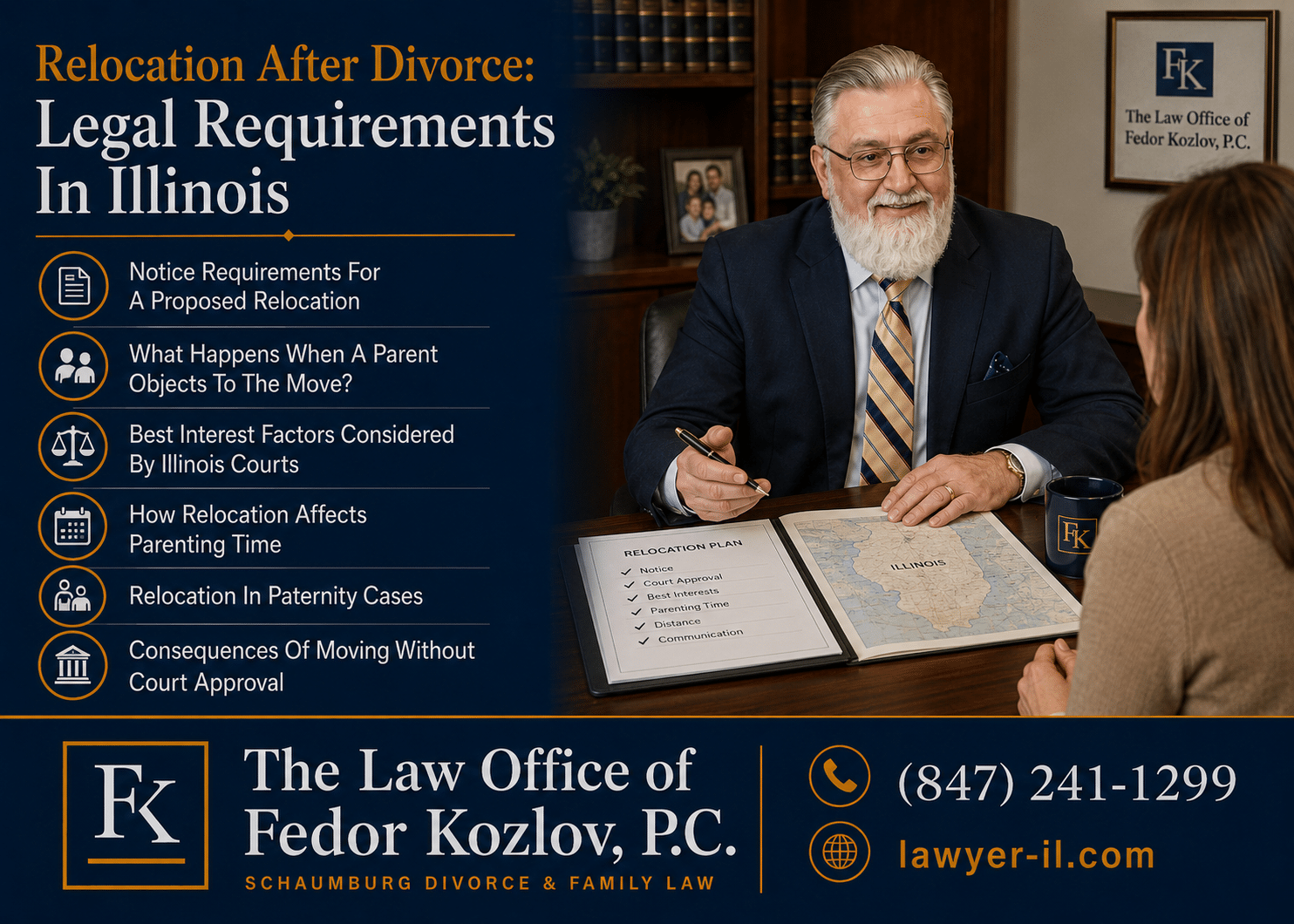
Divorce often changes many aspects of family life, including where parents live after the process is complete. Sometimes, a parent may get a new job, want to be closer to family, or need to move for financial reasons. While adults can usually move freely, things get more complicated when children are involved and the court has already set parenting responsibilities. Illinois law has clear rules that parents must follow before moving with a child. Not following these rules can lead to court penalties, changes to parenting plans, and other serious consequences. Whether you want to move with your child or are trying to prevent a move, it is important to understand Illinois relocation laws.
Understanding Relocation Under Illinois Law
Illinois relocation cases are governed primarily by Section 609.2 of the Illinois Marriage and Dissolution of Marriage Act, 750 ILCS 5/609.2. Under this statute, a relocation occurs when a parent who has been allocated a majority of parenting time or equal parenting time seeks to move with the child beyond certain geographic limits.
The law defines relocation differently depending on where the child currently resides. For children living in Cook County, DuPage County, Kane County, Lake County, McHenry County, and Will County, relocation generally means moving more than 25 miles from the child’s current primary residence. For children living in other Illinois counties, relocation generally means moving more than 50 miles from the child’s current residence. The law also addresses moves from Illinois to another state if the new residence is more than 25 miles from the current home.
Because of these distance rules, it is important to review any planned move before making decisions. Many parents are surprised that even a short move can count as a relocation and require court approval.
Notice Requirements For A Proposed Relocation
Illinois law requires a parent seeking relocation to provide advance written notice to the other parent. Section 609.2(d) of the Illinois Marriage and Dissolution of Marriage Act requires at least 60 days’ written notice before the intended move whenever possible.
The notice must contain important information, including:
- The intended date of relocation.
- The address of the new residence is known.
- The length of time the relocation is expected to last if it is not permanent.
If the other parent agrees to the move, they can sign the notice. The signed notice is then filed with the court. Often, this lets the relocation go forward without a long court process.
But if the other parent objects or will not sign the notice, the court usually needs to get involved before the move can happen.
What Happens When A Parent Objects To The Move?
When parents disagree about relocation, the court becomes responsible for determining whether the move serves the child’s best interests.
A parent seeking relocation must file a petition requesting court approval. The court will schedule hearings and allow both parties to present evidence regarding the proposed move.
Relocation disputes often involve complex questions concerning parenting time, school systems, employment opportunities, family support networks, transportation arrangements, and the child’s overall well-being.
The parent seeking relocation has the burden of showing that the move is in the child’s best interests. The opposing parent has the opportunity to present evidence demonstrating why the relocation may negatively affect the child or the parent-child relationship.
Because these cases often involve competing interests and emotional testimony, preparation and presentation of evidence can significantly impact the outcome.
Best Interest Factors Considered By Illinois Courts
Section 609.2(g) of the Illinois Marriage and Dissolution of Marriage Act outlines numerous factors that courts must consider when deciding whether relocation should be approved.
Among the factors considered are:
- The reasons for the proposed relocation.
- The reasons for the objection.
- The history and quality of each parent’s relationship with the child.
- Educational opportunities are available at both the current and proposed locations.
- The presence of extended family members.
- The anticipated impact on the child.
- The feasibility of preserving the relationship between the child and the non-relocating parent.
- The wishes of the child when appropriate.
- Any other factor affecting the child’s best interests.
No single factor controls the outcome. Judges evaluate the totality of the circumstances and make decisions based on what will best promote the child’s physical, emotional, educational, and developmental needs.
How Relocation Affects Parenting Time
Relocation frequently requires substantial modifications to existing parenting schedules. If a parent moves farther away, it is often not possible to keep the same parenting schedule. Courts may need to change parenting time to fit travel, school, and transportation needs.
For example, a parent who used to see their child several days a week might instead get longer visits during holidays, school breaks, or summer.
Illinois courts seek to preserve meaningful relationships between children and both parents whenever possible. As a result, judges often examine transportation logistics, communication methods, and scheduling alternatives that allow continued parent-child contact despite increased distance.
In many cases, relocation proceedings involve both a request to relocate and a request to modify parenting time under 750 ILCS 5/610.5.
Relocation In Paternity Cases
Relocation laws apply not only to divorced parents but also to parents involved in paternity proceedings. When parentage has been established and parenting responsibilities have been allocated, the same relocation requirements generally apply. A parent cannot avoid the statutory relocation process simply because the parties were never married.
Many unmarried parents share parenting time pursuant to court orders. If one parent wishes to relocate with the child beyond the statutory distance limits, court approval may still be required under Section 609.2.
Consequences Of Moving Without Court Approval
Relocating with a child without following Illinois legal requirements can create serious problems. A parent who moves without providing notice or obtaining necessary court approval may face contempt proceedings, emergency court orders requiring the child’s return, modifications of parenting responsibilities, and other sanctions.
Courts generally expect parents to comply with existing parenting orders until modifications are approved. Unilateral decisions that interfere with the other parent’s rights are often viewed unfavorably by judges.
Even when a parent believes relocation is necessary, it is usually far safer to obtain legal guidance and seek court approval before moving.
The Importance Of Early Legal Guidance
Relocation cases are among the most heavily contested family law matters in Illinois. They often involve competing concerns regarding employment, family support, educational opportunities, and the child’s relationship with both parents.
Whether you are seeking permission to relocate or you are attempting to prevent a move that could significantly affect your relationship with your child, early legal guidance can help protect your interests and your child’s future.
I represent parents on both sides of relocation disputes involving divorce, parenting time, child custody decisions, visitation rights, paternity matters, and related family law issues. Careful preparation, strong evidence, and a clear understanding of Illinois relocation statutes are often critical to achieving a favorable outcome.
Illinois Child Relocation Frequently Asked Questions
What Is Considered A Relocation Under Illinois Law?
Under 750 ILCS 5/609.2, relocation is determined by specific distance requirements based on where the child currently resides. For many families living in the greater Chicago area, a move of more than 25 miles from the child’s current residence may qualify as a relocation. Parents should review the statute carefully because even moves that seem relatively short can trigger legal requirements and court involvement.
Can I Move With My Child If The Other Parent Agrees?
Yes. If the other parent agrees to the relocation, the process is generally simpler. Illinois law allows the parties to sign a written notice containing the relocation details and file it with the court. However, court procedures still must be followed to ensure the relocation complies with applicable orders and statutory requirements.
What If The Other Parent Refuses To Consent To The Move?
If the other parent objects, you will generally need to file a petition asking the court to approve the relocation. The judge will evaluate the evidence and determine whether the move serves the child’s best interests. The court does not automatically approve or deny relocation requests. Each case is decided based on its specific facts and circumstances.
Does A Better Job Opportunity Guarantee Relocation Approval?
No. While employment opportunities can be an important factor, Illinois courts examine many different considerations. A higher-paying job may support a relocation request, but the court must still determine whether the move benefits the child overall. The effect on parenting time, educational opportunities, family relationships, and the child’s stability will also be evaluated.
Will The Court Consider My Child’s Preference?
In some situations, yes. Illinois courts may consider the wishes of a mature child depending on the child’s age, maturity, and ability to express reasoned preferences. However, a child’s preference is only one factor among many and does not automatically determine the outcome of the case.
Can Parenting Time Be Changed After Relocation?
Yes. Relocation often makes existing parenting schedules impractical. Courts frequently modify parenting time arrangements to account for travel distances and other logistical concerns. The goal is typically to preserve meaningful relationships between the child and both parents while accommodating the realities created by the move.
Does Relocation Law Apply To Unmarried Parents?
Yes. Parents involved in paternity cases are generally subject to the same relocation requirements when parenting responsibilities have been established by court order. The fact that the parents were never married does not eliminate the need for court approval when relocation statutes apply.
What Happens If A Parent Moves Without Permission?
Moving without complying with Illinois relocation laws can lead to significant legal consequences. Courts may order the child returned, modify parenting responsibilities, hold the parent in contempt, or impose other sanctions. Violating court orders can negatively affect future custody and parenting time disputes.
How Long Does A Relocation Case Take?
The timeline varies depending on the complexity of the dispute, court scheduling, and whether the parties can reach agreements. Some cases are resolved relatively quickly, while others require extensive hearings and evidence. Starting the process early is often important because Illinois law generally requires advance notice before relocation.
Do I Need A Lawyer For A Relocation Case?
Relocation cases often involve complicated legal and factual issues. The outcome can significantly affect your relationship with your child for years to come. Having legal representation can help ensure that evidence is properly presented, procedural requirements are satisfied, and your position is effectively advocated before the court.
Contact Our Parenting Time Lawyer In Schaumburg To Discuss Your Legal Options
Relocation disputes can have a lasting impact on parents and children. Whether you are seeking to relocate with your child or opposing a proposed relocation, it is important to understand your rights and obligations under Illinois law. I represent parents throughout Schaumburg and the Chicago area in divorce proceedings, child custody matters, parenting time disputes, visitation issues, paternity cases, and relocation proceedings. I work closely with clients to develop strategies that protect their relationship with their children and their long-term interests.
If you are facing a relocation dispute or have questions about parenting time, child custody, visitation rights, paternity, or divorce proceedings, contact the Law Office of Fedor Kozlov today. I represent clients in Schaumburg and throughout Chicago, Illinois. Contact our Schaumburg child relocation attorneys at the Law Office of Fedor Kozlov at (847) 241-1299 to receive a consultation and discuss your family law matter.
