
How To File For Divorce In Cook County
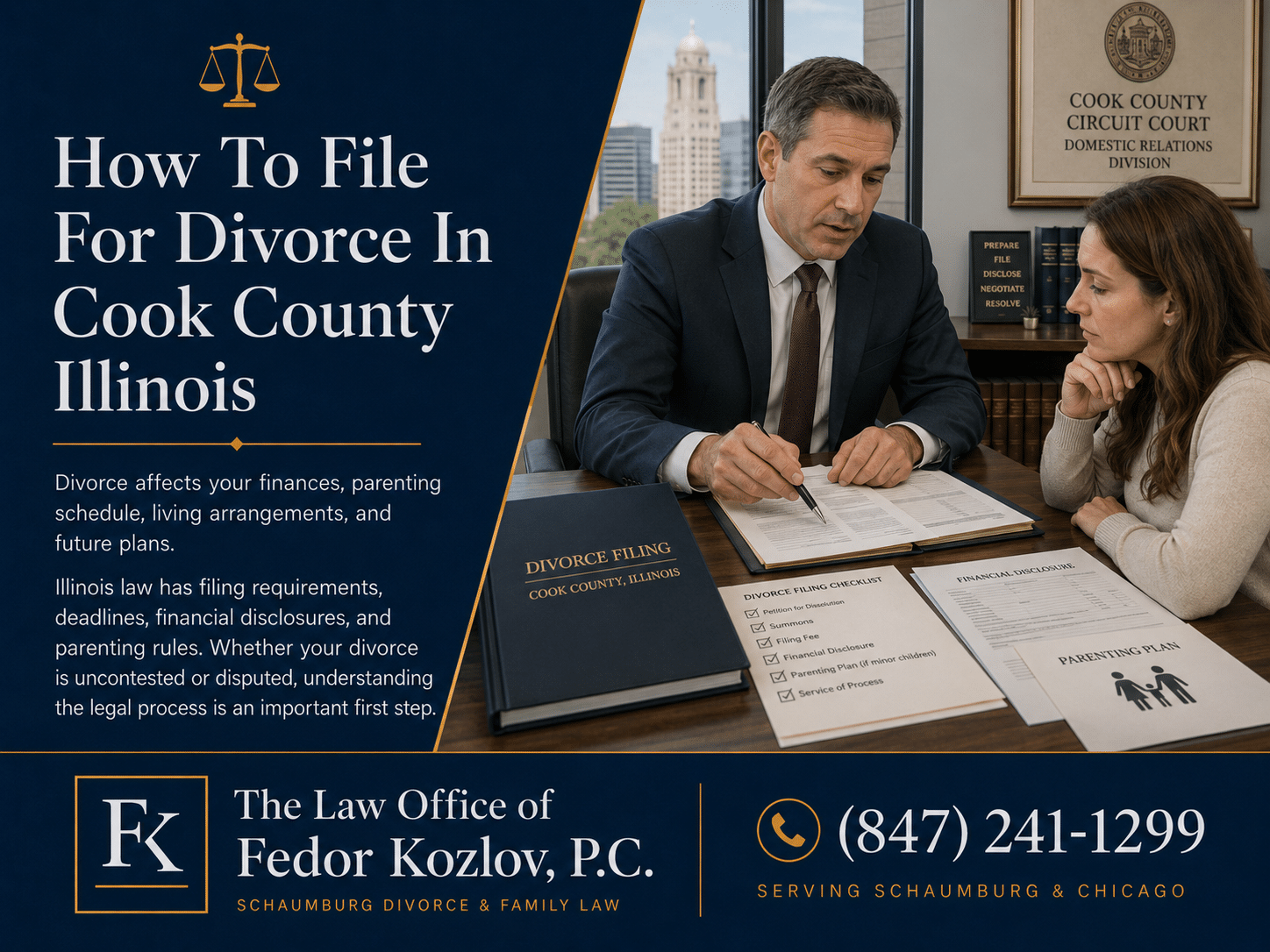
Divorce can impact your finances, parenting schedule, living arrangements, and future plans. Many people in Cook County are unsure how to start or what the court requires. Illinois divorce law sets specific filing requirements, deadlines, financial disclosures, and parenting rules that can influence your case. Early mistakes may be difficult to correct. Whether your divorce is uncontested or involves disputes over property, custody, or support, understanding the legal process is essential. I represent clients in Schaumburg and the Chicago area in divorce and family law matters, including contested divorces, parenting disputes, visitation, paternity, and other domestic relations cases.
Illinois Divorce Laws And Residency Requirements
Divorce cases in Illinois are governed primarily by the Illinois Marriage and Dissolution of Marriage Act, found at 750 ILCS 5/101. Before filing for divorce in Cook County, at least one spouse must satisfy the residency requirement under 750 ILCS 5/401(a). Illinois law requires either spouse to have resided in Illinois for at least 90 days before the entry of a judgment of dissolution of marriage.
Illinois is a no-fault divorce state. In Illinois, irreconcilable differences are the sole ground for divorce. This means that a spouse does not need to prove adultery, abandonment, cruelty, or other misconduct to obtain a divorce. Instead, the court focuses on whether the marriage has broken down beyond repair.
Cook County divorce cases are generally filed in the Circuit Court of Cook County. The filing spouse is known as the petitioner, while the other spouse is known as the respondent. The case usually must be filed in the county where either spouse resides.
Preparing To File For Divorce In Cook County
Before filing for divorce, gather all financial and personal information related to your marriage. Disputes often arise over income, debts, retirement accounts, real estate, parenting responsibilities, and support. Organized records help prevent delays and reduce future disputes.
Important records often include tax returns, bank statements, retirement account statements, mortgage documents, credit card statements, pay stubs, business records, child-related expenses, and insurance policies.
Illinois courts require complete financial disclosure during divorce. Concealing assets or income can result in court sanctions and negatively impact property division or support decisions.
If children are involved, prepare information about school schedules, childcare, healthcare providers, and daily routines. Parenting disputes are often among the most contested issues in divorce.
Filing The Petition For Dissolution Of Marriage
The divorce process begins when one spouse files a Petition for Dissolution of Marriage with the Circuit Court of Cook County. The petition identifies the parties, states the grounds for divorce, and outlines requests regarding property, parental responsibilities, parenting time, child support, maintenance, and related matters.
After filing, the respondent must be formally served with court papers unless service is waived. Illinois law regarding service of process is governed by 735 ILCS 5/2-201 and related provisions. Proper service is important because the court must have jurisdiction over both parties before issuing certain orders.
After receiving the petition, the respondent typically has 30 days to file a response. Failure to respond may result in a default judgment.
In many Cook County divorce cases, the court schedules initial status hearings soon after filing. The judge may address temporary matters such as child support, maintenance, possession of the marital residence, parenting schedules, or payment of household expenses while the case is pending.
Property Division In Illinois Divorce Cases
Illinois follows equitable distribution under 750 ILCS 5/503. Marital property is not always divided equally; instead, the court divides assets and debts in a manner it considers fair.
Marital property includes assets and debts acquired during the marriage, regardless of whose name is on the account or title. Separate property includes assets acquired before marriage, inheritances, gifts, and other non-marital property defined by Illinois law.
Courts consider many factors when dividing property, including:
- The length of the marriage
- Contributions made by each spouse
- The value of marital and non-marital property
- Economic circumstances of each spouse
- Child custody arrangements
- Future earning capacity
Property disputes are often complex when business interests, retirement accounts, investment assets, or significant debts are involved. Accurate asset valuation is critical in these cases. Illinois courts no longer uses the traditional terms “custody” and “visitation.” Instead, courts refer to the allocation of parental responsibilities and parenting time under 750 ILCS 5/600.
Parental responsibilities include decision-making authority for education, healthcare, religion, and extracurricular activities. Parenting time refers to the schedule for when the child is with each parent.
Illinois courts decide parenting matters based on the best interests of the child under 750 ILCS 5/602.7. Judges consider factors such as:
- The relationship between each parent and the child
- The child’s adjustment to home and school
- The mental and physical health of the parties
- The willingness of each parent to encourage the child’s relationship with the other parent
- Any history of abuse or violence
Cook County courts often require parents to complete parenting education courses during divorces involving minor children.
Finalizing A Divorce In Cook County
A divorce is final only after the court enters a Judgment for Dissolution of Marriage. Before this, all issues regarding property division, support, parental responsibilities, and parenting time must be resolved by agreement or decided by the judge.
Some divorces settle through negotiation or mediation, while others go to trial. If the parties agree, the court may approve a Marital Settlement Agreement and Parenting Plan. Once the judge signs the final judgment, both parties must comply with its terms. Violating court orders for support or parenting time can lead to enforcement actions, contempt hearings, wage garnishment, or other legal consequences.
FAQs About Filing For Divorce In Cook County
How Long Does A Divorce Take In Cook County?
The timeline depends on whether the divorce is contested or uncontested. Uncontested divorces may be completed in a few months if both parties agree on all issues. Contested divorces involving children, property, or finances can take much longer. Cases with business valuations, custody evaluations, or extensive litigation may last over a year. Court scheduling in Cook County also affects timing.
Do I Need To Prove My Spouse Did Something Wrong To Get Divorced?
No. Illinois is a no-fault divorce state. Irreconcilable differences are the only recognized ground for divorce. The court does not require proof of adultery, abuse, abandonment, or other misconduct. However, certain conduct may be relevant in disputes over parental responsibilities, asset dissipation, or protective orders.
What Happens If My Spouse Refuses To Sign Divorce Papers?
A spouse cannot stop a divorce by refusing to cooperate. If one spouse files and follows legal procedures, the case will proceed. If the respondent does not participate, the court may enter a default judgment. The filing spouse must still meet all procedural requirements and provide proper notice.
Will I Lose Custody Of My Children If I File For Divorce?
Filing for divorce does not automatically affect your parental rights. Illinois courts focus on the child’s best interests when deciding parental responsibilities and parenting time. Courts usually encourage both parents’ involvement unless there are concerns about abuse, neglect, substance abuse, or danger to the child.
Can I Stay In The Marital Home During The Divorce?
Often, one or both spouses remain in the marital home during divorce proceedings. Temporary court orders may determine who stays in the residence while the case is pending. The court considers financial circumstances, safety, and the children’s living arrangements.
Is Mediation Required In Cook County Divorce Cases?
Cook County courts often require mediation for parenting disputes. Mediation allows parents to resolve issues with a neutral third party. If unsuccessful, the case proceeds to litigation. Mediation can reduce conflict and help parents reach agreements without a lengthy trial.
Can Retirement Accounts Be Divided In A Divorce?
Yes. Retirement accounts accumulated during the marriage are usually considered marital property and subject to division. Some retirement assets require a Qualified Domestic Relations Order (QDRO) to divide benefits properly. Improper handling can result in tax consequences and financial losses. Illinois law requires full financial disclosure during divorce proceedings. If a spouse conceals property, income, or accounts, the court may impose sanctions or award a greater share of assets to the other spouse. Discovery tools such as subpoenas, depositions, and financial records requests are commonly used to investigate hidden assets.
Contact Our Schaumburg Divorce Law Attorney To Schedule A Consultation
Divorce can affect your children, finances, property rights, and long-term future. Whether you are facing disputes over custody, parenting time, property division, paternity, visitation, maintenance, or other family law matters, experienced legal representation is important. I represent clients in divorce and family law cases throughout Schaumburg and the greater Chicago area. The Law Office of Fedor Kozlov provides strategic representation tailored to each case.
If you are considering divorce in Cook County or have been served with divorce papers, the Law Office of Fedor Kozlov can help you understand your rights and legal options under Illinois law. Schedule a consultation with our Schaumburg divorce law attorney at the Law Office of Fedor Kozlov by calling (847) 241-1299. Our firm represents clients in Schaumburg and throughout Chicago.
