
Custody For Unmarried Parents In Illinois
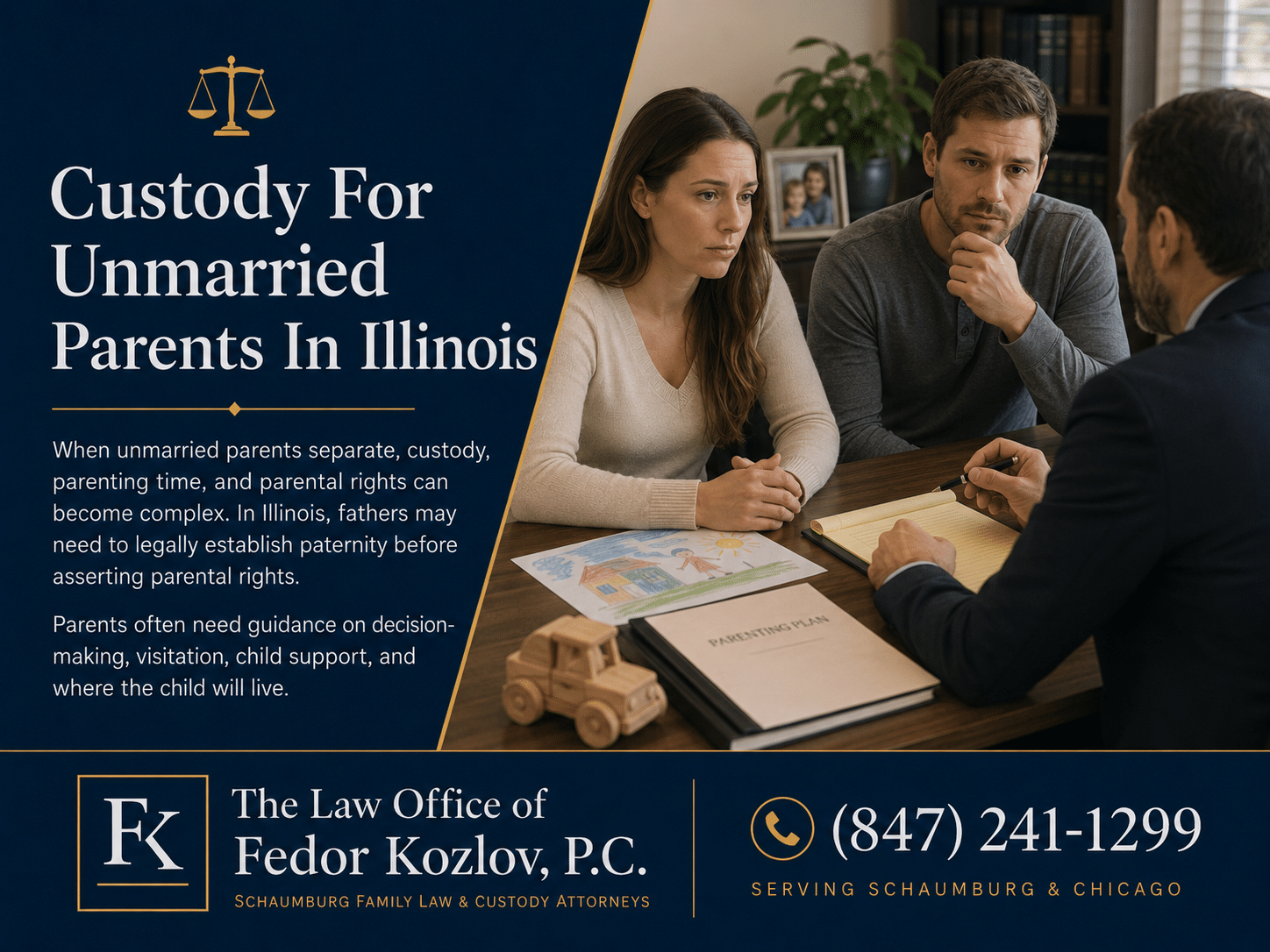
When unmarried parents separate, questions about custody, parenting time, and parental rights can be some of the most emotional and important legal issues a family faces. Many parents in Chicago are surprised to find that unmarried fathers do not have the same legal rights as married fathers until paternity is legally established. Both mothers and fathers may worry about where their child will live, who will make major decisions, how visitation will work, and whether child support will be required. Illinois family courts focus on protecting the best interests of the child in these situations. I help parents in Schaumburg and the Chicago area who need guidance with parental responsibilities, parenting time disputes, paternity cases, custody changes, and other family law matters under Illinois law.
Understanding Custody Laws For Unmarried Parents In Illinois
Illinois law no longer uses the term “custody” in the same way many people still commonly use it. Under the Illinois Marriage and Dissolution of Marriage Act, courts now refer to these issues as the allocation of parental responsibilities and parenting time. Relevant provisions can be found under 750 ILCS 5/600.
Parental responsibilities mean having the authority to make important decisions for a child, such as those about education, healthcare, religion, and activities outside of school. Parenting time is the schedule that shows when each parent will be with the child.
Once parentage is legally established, unmarried parents usually have the same rights and responsibilities as divorced parents. However, legal issues can come up because unmarried fathers do not automatically have enforceable parental rights without going through a formal legal process.
Illinois courts do not automatically favor mothers or fathers when making decisions involving children. Instead, courts examine what arrangement serves the child’s best interests.
Establishing Paternity In Illinois
Before an unmarried father can seek parenting time or parental responsibilities, paternity usually must be established. Under the Illinois Parentage Act of 2015, found at 750 ILCS 46/101, parentage can be established voluntarily or through court proceedings.
Some parents sign a Voluntary Acknowledgment of Paternity at the hospital following the birth of the child. When properly completed, this document creates a legal father-child relationship. However, disputes sometimes arise later involving parental rights, custody, visitation, or child support.
If paternity has not been established voluntarily, either parent may file a parentage action with the court. The court may order DNA testing to determine biological parentage. Once parentage is confirmed, the court can enter orders regarding parenting time, decision-making authority, and child support.
Paternity cases can become highly contested. One parent may deny parentage, dispute visitation rights, or seek limitations on parental involvement. These cases often involve significant emotional and financial consequences for everyone involved.
How Illinois Courts Decide Parenting Time And Decision-Making Authority
Illinois courts evaluate multiple statutory factors when determining parenting arrangements for unmarried parents. Illinois courts consider the child’s best interests above all else.
The court may examine:
- The wishes of each parent.
- The child’s relationship with each parent.
- The child’s adjustment to home, school, and community.
- The mental and physical health of the parties.
- Each parent’s ability to cooperate.
- Any history of domestic violence or abuse.
- The willingness of each parent to encourage a relationship with the other parent.
Judges look closely at whether both parents can communicate well and put the child’s needs first. Courts usually support both parents being involved in the child’s life when it is appropriate and safe.
Sometimes, one parent has most of the parenting time, but both parents still share decision-making. In other cases, one parent may get full decision-making authority if the parents cannot work together or if there are concerns about the child’s safety or well-being.
Visitation Rights For Unmarried Parents
Disagreements about parenting time are common for unmarried parents. One parent might think the other should have less involvement because of instability, substance abuse, criminal issues, or worries about the child’s safety. The other parent may feel they are being unfairly kept from their child.
Illinois courts generally support ongoing parent-child relationships unless evidence shows that restrictions are necessary. Under 750 ILCS 5/603.10, courts may impose restrictions on parenting time if a parent’s conduct seriously endangers the child’s physical, mental, moral, or emotional health.
Restrictions might include supervised visits, limits on overnight stays, drug testing, or other protective steps. Courts look at the evidence closely before deciding to limit a parent’s rights.
Parents should know that informal verbal agreements can cause problems in the future. Having a formal court order sets clear, enforceable rules for parenting schedules, holidays, transportation, and communication with the child.
Modifying Custody And Parenting Orders
Parenting arrangements sometimes need to change as children get older or family situations change. Illinois law allows these changes in certain situations.
Under 750 ILCS 5/610.5, courts may modify parenting time or parental responsibilities when a substantial change in circumstances has occurred, and modification serves the child’s best interests.
Examples may include:
- Relocation by one parent
- Significant changes in work schedules
- Concerns involving substance abuse
- Domestic violence allegations
- Ongoing interference with parenting time
- Changes in the child’s educational or medical needs
Parents should not make major changes without getting court approval. Breaking a current parenting order can hurt your chances in future custody cases.
Why Legal Representation Matters In Unmarried Parent Cases
Cases with unmarried parents can become complicated both legally and emotionally. Disagreements about paternity, visitation, parental responsibilities, moving, and child support can have long-lasting effects on both parents and children.
I work with mothers and fathers throughout Schaumburg and the Chicago area who need legal guidance regarding family law disputes. Whether you are seeking parenting rights, responding to a custody petition, establishing paternity, or requesting changes to an existing order, it is important to understand your legal rights under Illinois law.
A carefully prepared parenting agreement and court order can reduce future conflict and provide stability for your child. Protecting your relationship with your child may require immediate legal action depending on the circumstances of your case.
FAQs About Custody For Unmarried Parents In Illinois
Does An Unmarried Mother Automatically Have Custody In Illinois?
When a child is born to unmarried parents, the mother initially has sole legal rights to the child until parentage is established and the court enters custody-related orders. However, once paternity is legally established, fathers may petition for parenting time and parental responsibilities. Illinois courts do not automatically favor one parent over the other after parentage has been confirmed.
Does Signing A Birth Certificate Give A Father Custody Rights?
Signing a birth certificate by itself may not give a father full legal rights. Often, parents also fill out a Voluntary Acknowledgment of Paternity. Even after this, the father usually needs a court order to get parenting time or responsibilities. Without a court order, it can be hard to settle disagreements about visitation and decision-making.
Can A Father Get Equal Parenting Time In Illinois?
Yes. Illinois courts can give equal or almost equal parenting time if it is best for the child. They look at things like each parent’s involvement, ability to communicate, work schedules, living situations, and willingness to support the child’s relationship with the other parent. Equal parenting time is not guaranteed, but it is possible in the right cases.
What Happens If One Parent Refuses Visitation?
If there is a valid court order and one parent blocks parenting time, the other parent can ask the court to enforce the order. Illinois courts take these violations seriously. A judge might order makeup time, change the parenting plan, give penalties, or hold the parent in contempt of court.
Can Grandparents Seek Visitation Rights In Illinois?
In some situations, grandparents and certain other relatives can ask for visitation under 750 ILCS 5/602.9. Courts look at whether visits are in the child’s best interests and if denying visits would harm the child’s mental, physical, or emotional health. These cases depend a lot on the specific facts.
Can Parenting Orders Be Changed Later?
Yes. Parenting orders may be modified if substantial changes in circumstances occur. Courts evaluate whether modification serves the child’s best interests. Parents commonly seek modifications after relocations, schedule changes, remarriage, school issues, or concerns involving the child’s safety and well-being.
What If The Parents Never Went To Court?
Many unmarried parents start with informal agreements about parenting schedules and financial support. Sadly, disagreements often come up later. Without a formal court order, it is hard to enforce these agreements. Getting a legal order can give both parents and children more clarity and stability.
Can A Parent Move Away With The Child?
Moving away with a child can be complicated under Illinois law. Under 750 ILCS 5/609.2, a parent who wants to move beyond certain distance limits may need court approval. Courts consider how the move would affect the child’s relationship with both parents, schooling, family support, and overall well-being.
How Long Does A Parentage Or Custody Case Take?
The timeline depends on the complexity of the case and whether disputes exist regarding paternity, parenting time, or decision-making authority. Some uncontested matters may resolve relatively quickly, while highly contested custody cases can take many months. Cases involving evaluations, investigations, or extensive litigation often require additional time.
Call Our Schaumburg Divorce Attorney To Weigh Your Legal Options
Custody disputes between unmarried parents can impact every part of your child’s future and your relationship with them. Whether you are a mother looking for support and protection or a father seeking parenting time and rights, getting legal help early can make a big difference.
The Law Office of Fedor Kozlov helps clients in Schaumburg and across Chicago, Illinois, with family law issues like custody disputes, parenting time, visitation rights, paternity, divorce, and related matters. Schedule a consultation with our Schaumburg divorce attorney at the Law Office of Fedor Kozlov by calling (847) 241-1299. Our firm represents clients in Schaumburg and Chicago.
