
Can A Divorce Be Finalized Without Both Spouses Signing?
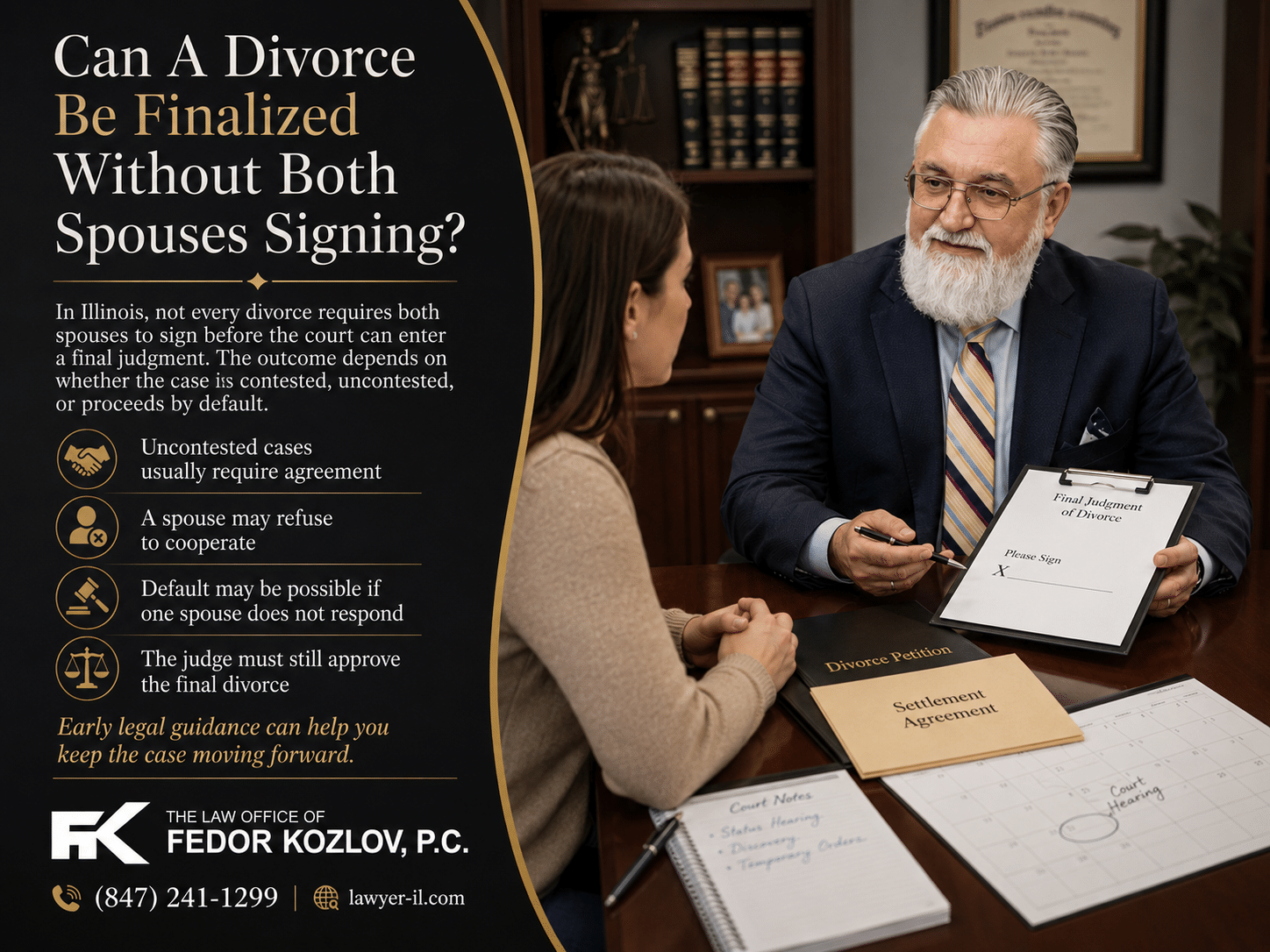
Many people in Schaumburg are surprised to learn that a divorce can often move forward even when one spouse refuses to cooperate. A common misconception is that both spouses must agree to the divorce and sign all paperwork before a court can legally end the marriage. In Illinois, that is generally not the case. While an unwilling spouse may create delays, increase costs, and make the process more complicated, that person typically cannot prevent a divorce simply by refusing to sign documents. Illinois law provides procedures that allow courts to resolve disputes and finalize a divorce even when one spouse objects or refuses to participate. Understanding how these situations are handled can help reduce uncertainty and provide a clearer picture of what to expect during the divorce process.
Illinois Is A No-Fault Divorce State
Illinois follows a no-fault divorce system. Under Section 401 of the Illinois Marriage and Dissolution of Marriage Act, 750 ILCS 5/401, a marriage may be dissolved based upon irreconcilable differences. The law does not require one spouse to prove wrongdoing by the other spouse in order to obtain a divorce.
Irreconcilable differences generally mean that the marriage has broken down beyond repair and that attempts at reconciliation have failed or would not be in the family’s best interests. If one spouse believes the marriage should end, the court may ultimately grant a divorce even if the other spouse strongly disagrees.
This legal framework prevents situations where one person can indefinitely force the other to remain married. Although cooperation is often helpful and can make the process more efficient, a spouse’s refusal to sign documents does not automatically stop the divorce from moving forward.
Why Some Spouses Refuse To Sign Divorce Papers
There are many reasons why a spouse may refuse to sign divorce papers. In some situations, the refusal is driven by emotional factors such as anger, denial, or a desire to save the marriage. In other cases, a spouse may hope to gain leverage in negotiations involving property division, child custody, parenting time, child support, or spousal maintenance.
Some individuals mistakenly believe that refusing to sign documents will prevent the divorce from occurring. Others use delay tactics in an effort to frustrate the other spouse or increase litigation costs. While these tactics can create obstacles, Illinois courts have mechanisms in place to address uncooperative behavior.
It is important to understand that refusing to sign a settlement agreement is different from refusing to sign divorce papers entirely. A spouse has the right to disagree with proposed settlement terms. However, disagreement over terms does not prevent the court from ultimately resolving those disputes through litigation.
What Happens After A Divorce Petition Is Filed?
A divorce case begins when one spouse files a Petition For Dissolution Of Marriage. The filing spouse must then ensure that the other spouse receives proper notice of the case through service of process.
Once served, the responding spouse has an opportunity to file a response and participate in the proceedings. If the responding spouse chooses to participate, the parties may exchange information, negotiate settlements, attend mediation if required, and appear before the court as necessary.
The court retains authority over the case regardless of whether both spouses agree on every issue. If disputes cannot be resolved voluntarily, the judge may conduct hearings and ultimately issue decisions that are binding on both parties.
Can A Divorce Be Finalized If One Spouse Refuses To Participate?
Yes. In many situations, a divorce can be finalized even when one spouse refuses to participate. If a spouse is properly served and fails to respond within the required time period, the court may enter a default order.
A default judgment allows the case to proceed despite the lack of participation from one party. The court will still review evidence and ensure that legal requirements are satisfied, but the nonparticipating spouse may lose the opportunity to fully present arguments regarding contested issues.
Default proceedings are not automatic. The filing spouse must follow procedural requirements and demonstrate that proper notice was provided. However, once those requirements are met, a spouse cannot indefinitely delay the case simply by ignoring it.
Parenting Time And Child Custody Issues Still Require Court Review
When children are involved, Illinois courts focus on protecting the child’s best interests regardless of whether one parent refuses to cooperate. Illinois no longer uses the traditional term custody in most family law cases. Instead, courts allocate parental responsibilities and parenting time.
Under 750 ILCS 5/602.5, courts determine how significant decision-making responsibilities should be allocated between parents. These responsibilities may involve education, health care, religion, and extracurricular activities.
Parenting time is governed by 750 ILCS 5/602.7. Courts evaluate numerous factors when determining parenting schedules, including the child’s needs, each parent’s relationship with the child, the willingness of the parents to cooperate, and the child’s adjustment to home, school, and community.
A parent’s refusal to sign documents does not automatically affect parental rights. However, persistent refusal to cooperate may become relevant when the court evaluates each parent’s ability to act in the child’s best interests.
Property Division Does Not Require Both Spouses To Agree
Property disputes frequently become a source of conflict during divorce proceedings. Illinois follows equitable distribution principles under 750 ILCS 5/503. Marital property is divided fairly based upon the circumstances of the case rather than through an automatic fifty-fifty division.
While many cases settle through negotiation, not every couple reaches an agreement. If one spouse refuses to sign a proposed settlement, the court can hold hearings, review evidence, and determine how marital assets and debts should be divided.
This authority extends to bank accounts, retirement accounts, real estate, business interests, investments, and other forms of marital property. The court’s decision becomes binding even if one spouse disagrees with the outcome.
What If A Spouse Avoids Being Served?
Some spouses attempt to avoid service because they believe doing so will prevent the divorce from moving forward. In reality, avoiding service rarely succeeds in stopping a case.
Illinois law allows courts to consider alternative service methods when reasonable efforts to locate and serve a spouse have been unsuccessful. The court’s primary concern is ensuring that reasonable notice has been provided.
Once proper notice requirements have been satisfied, the case can generally continue even if the spouse attempts to avoid participation. Courts are well aware of these tactics and have procedures designed to prevent unnecessary delays.
Why Legal Representation Can Be Important In Contested Divorces
Cases involving uncooperative spouses often become more complex than uncontested divorces. Issues involving parenting time, parental responsibilities, visitation rights, support, paternity, and property division may require court intervention when the parties cannot reach an agreement.
Obtaining legal guidance early in the process can help identify potential challenges and ensure that procedural requirements are satisfied. Every case involves unique facts, and the strategy that works best in one situation may not be appropriate in another.
Understanding your rights and responsibilities from the beginning can help you make informed decisions and avoid mistakes that could affect the outcome of your case.
Illinois Divorce Frequently Asked Questions
Can A Divorce Be Finalized Without Both Spouses Signing?
Yes. Illinois courts can finalize a divorce even if one spouse refuses to sign documents or refuses to participate. A spouse’s lack of cooperation may create delays, but it generally cannot prevent a divorce from being granted when legal requirements are met.
Can My Spouse Stop The Divorce By Refusing To Sign?
No. Illinois is a no-fault divorce state. If one spouse seeks a divorce based on irreconcilable differences, the court may ultimately dissolve the marriage regardless of whether the other spouse agrees.
What Happens If My Spouse Ignores Divorce Papers?
If a spouse is properly served and fails to respond, the court may enter a default order. This can allow the divorce case to proceed without the spouse’s active participation.
Does A Judge Need Both Signatures To Grant A Divorce?
No. While signatures may be required for settlement agreements and certain procedural documents, a judge does not need both spouses to agree before entering a judgment for dissolution of marriage.
Can Parenting Time Be Determined Without My Spouse’s Agreement?
Yes. If parents cannot agree, the court may determine parenting time under 750 ILCS 5/602.7 based upon the child’s best interests. Judicial intervention is common in contested parenting disputes.
What Happens If My Spouse Refuses To Sign A Parenting Plan?
The court may review evidence and establish a parenting arrangement if the parties cannot reach an agreement. The child’s best interests remain the primary consideration.
Can Property Be Divided Without Both Spouses Agreeing?
Yes. Under 750 ILCS 5/503, Illinois courts may divide marital property when the parties cannot reach a settlement. The judge’s ruling becomes legally binding.
Can A Divorce Take Longer If One Spouse Refuses To Cooperate?
Yes. Refusing to cooperate may increase litigation, require additional court hearings, and extend the overall timeline. However, delays do not necessarily prevent the divorce from eventually being finalized.
Contact Our Schaumburg Divorce Attorney To Protect Your Interests
A spouse’s refusal to sign documents can create frustration and uncertainty, but it does not necessarily prevent a divorce from moving forward. Illinois courts have authority to address contested issues involving parenting time, parental responsibilities, visitation rights, paternity, support, and property division. Understanding your options early can help you protect your interests and move forward with greater confidence.
At the Law Office of Fedor Kozlov, I represent clients in Schaumburg and throughout Chicago, Illinois in divorce proceedings, parenting time disputes, parental responsibility matters, visitation issues, paternity cases, and other family law matters. If your spouse refuses to sign divorce papers or is creating obstacles during the divorce process, contact our Schaumburg divorce attorneys at the Law Office of Fedor Kozlov at (847) 241-1299 to receive a consultation.
