
Parallel Parenting Vs. Co-Parenting After Divorce
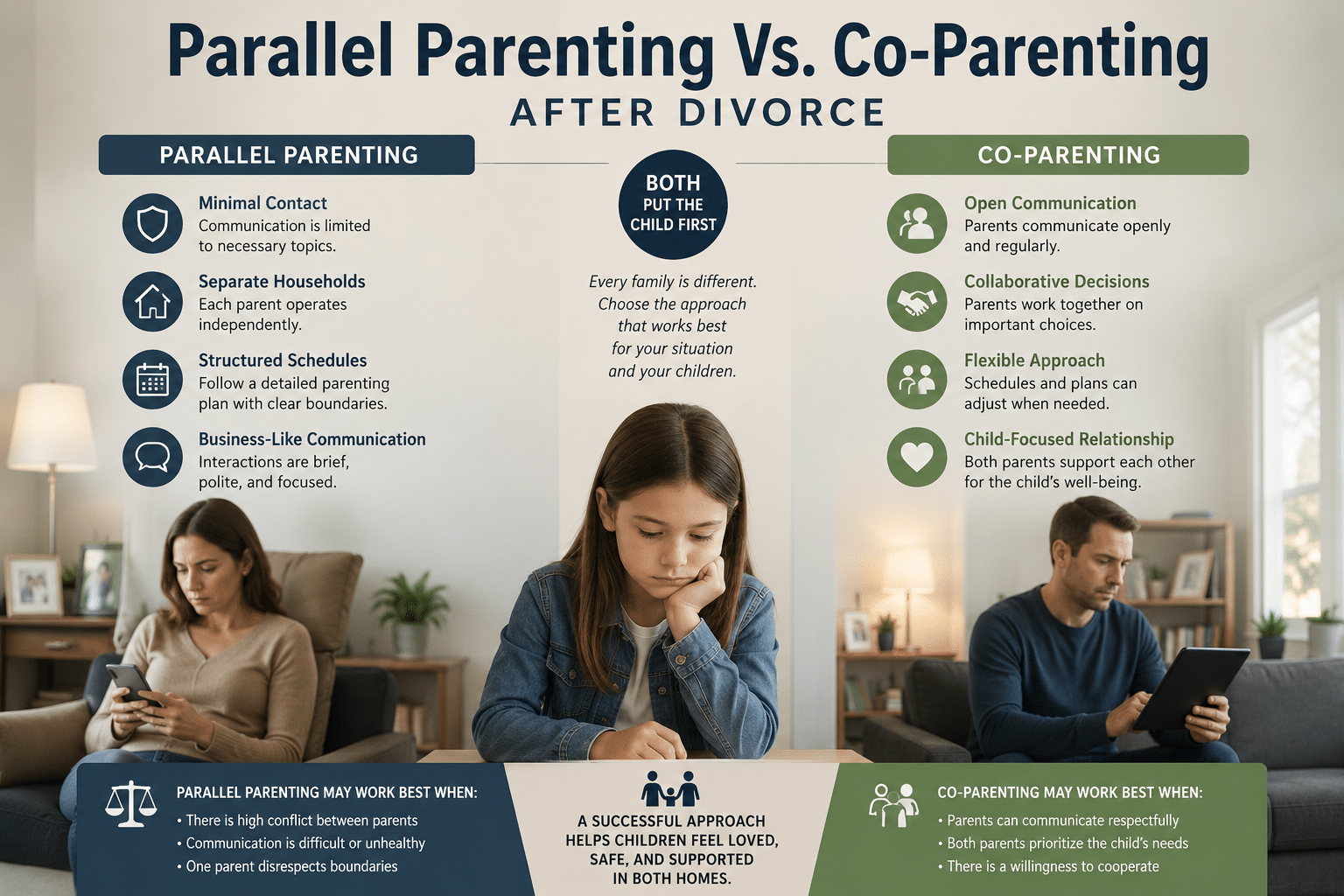
Divorce ends a marriage, but parents often stay connected through their children for years. How parents communicate and make decisions after divorce can strongly affect everyone involved. Some parents in Schaumburg work well together using co-parenting, while others find that too much contact leads to more conflict. In those cases, parallel parenting offers a structured way to limit unnecessary interaction but still lets both parents stay involved. It’s important for parents to know the differences between these approaches, since the best choice depends on the family’s situation, the level of conflict, and what is best for the children under Illinois law.
Understanding Co-Parenting After An Illinois Divorce
Co-parenting means that divorced or separated parents talk regularly and work together on issues that affect their children. They might discuss things like school, medical appointments, activities, schedules, and other daily matters. For co-parenting to work well, parents need to trust each other, cooperate, and be willing to compromise.
Illinois law does not require divorced parents to become friends or maintain a close personal relationship. The Illinois Marriage and Dissolution of Marriage Act instead focuses on parental responsibilities and parenting time. Under 750 ILCS 5/602.5, significant decision-making responsibilities may be allocated to one or both parents for important matters involving education, health, religion, and extracurricular activities. When parents share significant decision-making responsibilities, effective communication often becomes particularly important because they may be required to discuss major decisions affecting their child.
Co-parenting works best when both parents respect each other’s boundaries and keep conversations about the children. Problems can happen if every talk becomes an argument, if one parent tries to control the other, or if old issues from the marriage affect parenting decisions.
What Parallel Parenting Means
Parallel parenting is a structured way for parents to reduce direct contact with each other. Instead of talking often about daily matters, each parent usually makes routine decisions when the children are with them. Communication is limited to important topics and often happens through email, text, parenting apps, or another agreed method.
Parallel parenting does not mean one parent is absent from the child’s life. Both parents can still be active and have meaningful time with their children. The main difference is that parents avoid unnecessary contact and follow a detailed plan to reduce disagreements.
This approach helps when parents have shown that regular co-parenting leads to conflict. A detailed plan can set exact exchange times, transportation duties, ways to communicate, holiday schedules, and how to handle school or medical information. The goal is to make things predictable so parents don’t have to renegotiate routine issues every week.
How Illinois Courts Determine Parenting Time
Illinois courts allocate parenting time according to the child’s best interests under 750 ILCS 5/602.7. The statute requires courts to consider numerous factors, including each parent’s wishes, the child’s wishes when appropriate, the amount of caretaking performed by each parent, the child’s relationship with parents and siblings, the child’s adjustment to home and school, and the ability of the parents to cooperate with the parenting arrangement.
The law also looks at whether each parent puts the child’s needs first and supports the child’s relationship with the other parent. This is especially important in high-conflict cases. If a parent keeps interfering with parenting time, uses the children to send messages, or starts unnecessary arguments, it can affect future court decisions.
Neither co-parenting nor parallel parenting changes the underlying best-interests standard. The court’s concern is whether the parenting structure provides stability, protects the child, and allows parental responsibilities to be exercised effectively.
How Decision-Making Responsibilities Work With Parallel Parenting
Some parents assume that parallel parenting automatically means each parent has complete authority whenever the child is in that parent’s home. Illinois law is more specific. Under 750 ILCS 5/602.5, significant decision-making responsibilities concerning important areas such as education, health, religion, and extracurricular activities may be allocated jointly or individually.
A parenting plan can separate major decisions from routine ones. Section 602.5 says that a parent usually handles routine and emergency decisions about a child’s health and safety during their own parenting time. This setup allows parallel parenting to work, even if parents have trouble communicating, since many daily matters can be managed alone.
If significant decisions are shared, however, the parents may still need an established process for discussing them. A carefully written parenting plan can specify how information will be exchanged, how much time a parent has to respond, and how disagreements will be addressed. Greater detail can reduce the opportunity for recurring arguments.
When Co-Parenting May Be The Better Choice
Co-parenting is usually preferable Co-parenting is often best when parents can talk productively and set aside personal issues. Children benefit when parents can go to school events, share information easily, adjust schedules when needed, and support each other’s role in the child’s life. A cooperative parenting relationship allows parents to make reasonable scheduling adjustments without turning every change into a legal dispute. If a work obligation arises or a child wants to attend a special event, cooperative parents may be able to resolve the issue quickly.
However, flexibility only works when it is mutual. If one parent constantly asks for accommodations while refusing to provide the same consideration, informal arrangements can create resentment and conflict. Even cooperative parents benefit from having a detailed written parenting plan that establishes clear expectations.
When Parallel Parenting May Be More Appropriate
Parallel parenting may be useful when communication consistently results in hostility, accusations, manipulation, or prolonged arguments. It can also be appropriate when parents disagree about nearly every parenting decision and the conflict itself is beginning to affect the children.
A structured parallel parenting arrangement can reduce the number of decisions that require direct negotiation. Exchanges can occur at school or another neutral location, communication can be limited to child-related subjects, and routine matters can be handled independently. Parents can also use written communication rather than telephone conversations, creating a clear record while reducing emotional confrontations.
The purpose should not be to punish the other parent or eliminate that parent’s relationship with the children. Parallel parenting should instead reduce conflict while preserving each parent’s appropriate role.
High-Conflict Parenting And Restrictions On Parenting Time
Parallel parenting should not be confused with restricted or supervised parenting time. Parents can have significant conflict with each other while both remain capable and appropriate parents.
Under 750 ILCS 5/603.10, a court may restrict parental responsibilities when it finds, after a hearing, that a parent’s conduct seriously endangered the child’s mental, moral, or physical health or significantly impaired the child’s emotional development. Restrictions may include reduced parenting time, supervised parenting time, protected exchanges, or other measures necessary to protect the child.
The legal standard for restrictions is therefore different from simply determining that parents communicate poorly. Parallel parenting may address conflict between otherwise capable parents, while restrictions address conduct that creates a serious concern for the child’s welfare.
Creating A Detailed Parenting Plan Can Prevent Future Disputes
A vague parenting plan can create repeated problems for parents who already struggle to communicate. Statements such as “the parents will cooperate regarding holidays” or “parenting time will occur as mutually agreed” may sound reasonable when everyone is getting along, but they provide little guidance once disagreements begin.
In a higher-conflict case, I generally want important details addressed clearly. The plan may identify exact parenting times, exchange locations, holiday schedules, transportation responsibilities, communication methods, notice requirements for schedule changes, access to school and medical information, and procedures for significant decisions.
Detailed provisions can reduce the number of situations requiring negotiation. That can benefit both parents and, more importantly, reduce children’s exposure to continuing parental conflict.
Speak With A Schaumburg Family Law Lawyer Today
Choosing between parallel parenting and co-parenting is not about determining which parent is right or wrong. The central issue is creating a workable structure that protects the children from unnecessary conflict while preserving appropriate parental involvement. I represent parents on either side of disputes involving divorce, allocation of parental responsibilities, parenting time, visitation rights, paternity, and related family law matters. I can evaluate the history between the parents, the existing parenting arrangement, and the needs of the children when determining what type of parenting plan may be appropriate.
At the Law Office of Fedor Kozlov, I represent clients in Schaumburg and throughout Chicago, Illinois who are facing divorce and family law disputes involving children. Whether you are trying to establish a workable parenting plan, dealing with a high-conflict former spouse, seeking changes to parenting time, or responding to another parent’s request concerning parental responsibilities, I can help you understand the legal issues involved and the options available under Illinois law. Contact our Schaumburg divorce attorney at the Law Office of Fedor Kozlov at (847) 241-1299 to receive a consultation.
