
What Happens To IVF Embryos When A Marriage Ends?
When a marriage ends, couples face tough questions about property, finances, parenting, and future plans. For those who have used in vitro fertilization (IVF), deciding what happens to frozen embryos can be especially emotional and complicated. Many are surprised to find that Illinois courts handle embryo disputes differently than traditional child custody cases. The outcome often depends on any agreements made before IVF, each person’s intentions, and the details of the situation. Since these decisions can affect your ability to have children in the future, it’s important to know how Illinois law addresses these cases and what factors might influence a court’s ruling.
Understanding IVF Embryos In Illinois Divorce Cases
IVF is a medical process where eggs and sperm are joined outside the body to make embryos that can be implanted later. Couples often end up with several embryos, and some are kept frozen for possible future use.
After a marriage ends, spouses might not agree on what to do with their embryos. One person may want to use them to have a child, while the other may not. Sometimes, they may also disagree about whether to keep the embryos frozen, donate them, or have them destroyed.
Illinois courts understand that disputes over embryos involve important personal, ethical, and legal issues. Unlike parenting time or custody matters, embryos are usually not treated as children under family law. Instead, courts often look at these cases using contract law and constitutional rights, rather than the rules for child custody.
The Importance Of IVF Agreements
A key factor in embryo disputes is whether the couple signed an agreement with the fertility clinic before starting treatment.
Most fertility centers require intended parents to sign documents specifying what should happen to stored embryos under various circumstances, including divorce, death, separation, or long-term storage issues.
Illinois courts often look first to these agreements when determining the parties’ rights and obligations. If the agreement clearly addresses what happens in the event of divorce, the court may enforce that provision.
For example, an agreement might say that embryos will be destroyed if the couple divorces, donated for research, or given to one spouse. Courts usually prefer to enforce valid agreements because they show what both people wanted when the embryos were created.
However, disputes can arise when agreements are unclear, incomplete, contradictory, or challenged by one of the parties.
How Illinois Courts Evaluate Embryo Disputes
Illinois courts handle embryo disputes by weighing both sides’ interests. They know that one person may really want to use the embryos to become a parent, while the other may not want to become a parent at all.
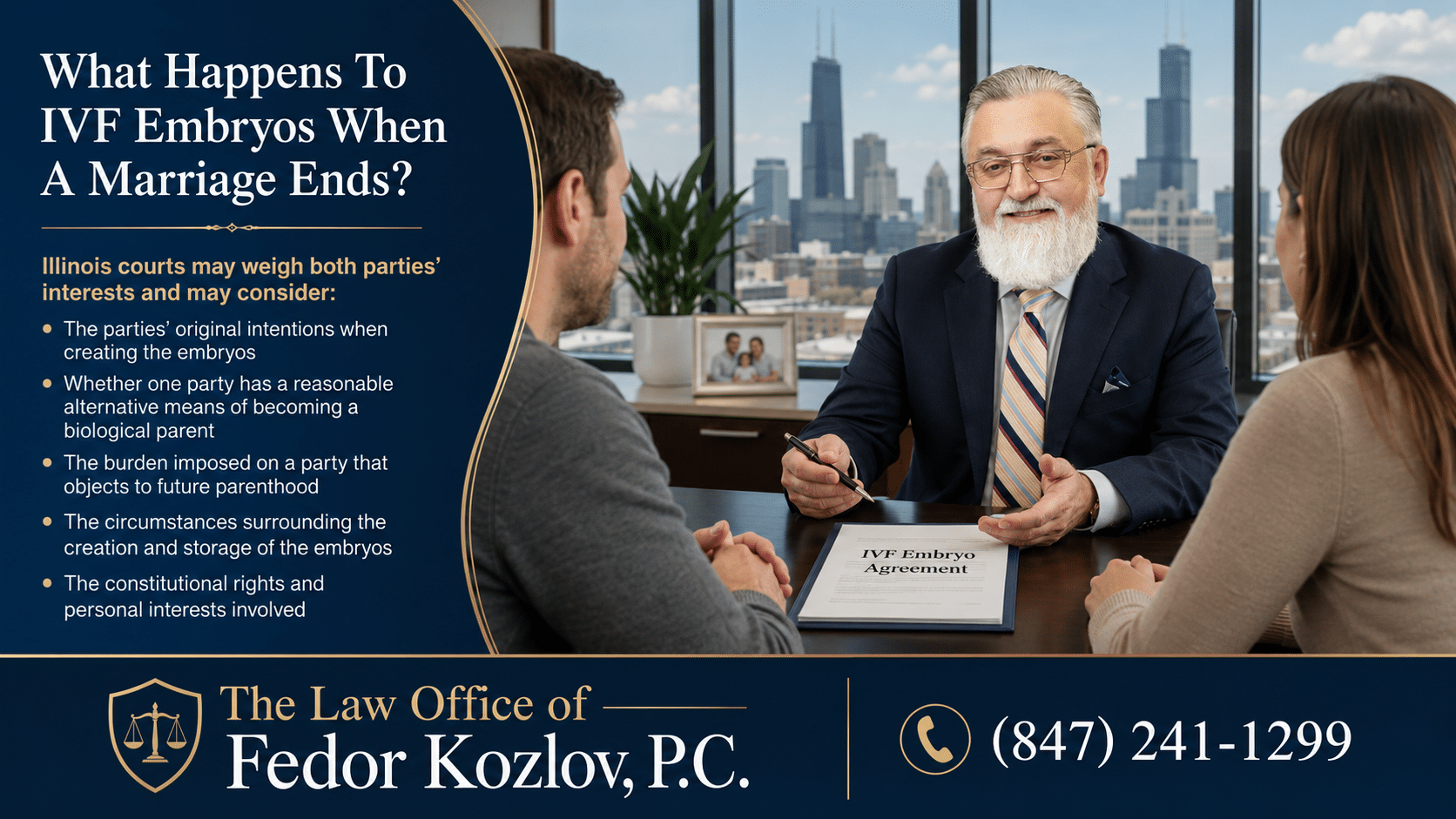
If there is no clear agreement, courts may look at several factors, such as:
- The parties’ original intentions when creating the embryos.
- Whether one party has a reasonable alternative means of becoming a biological parent.
- The burden imposed on a party that objects to future parenthood.
- The circumstances surrounding the creation and storage of the embryos.
- The constitutional rights and personal interests are involved.
Since every case is different, the outcome usually depends a lot on the details given to the court.
Distinguishing Embryo Disputes From Child Custody Cases
Many people think embryo disputes are handled like child custody cases. In fact, Illinois courts usually do not treat frozen embryos as children when deciding parental responsibilities or parenting time.
When a child has already been born, courts apply the best interests of the child standard under the Illinois Marriage and Dissolution of Marriage Act. Parental responsibilities and parenting time issues are governed by 750 ILCS 5/602.5 and 750 ILCS 5/602.7.
Section 602.5 addresses the allocation of significant decision-making responsibilities involving a child’s education, healthcare, religion, and extracurricular activities. Section 602.7 governs parenting time and requires courts to evaluate the child’s best interests when establishing visitation and parenting schedules.
These laws apply to children who have already been born. Frozen embryos are usually in a different legal category, so courts do not use the best interests test when deciding who controls the embryos.
How Embryo Disputes Can Affect Future Family Law Matters
Although embryo disputes are separate from custody proceedings, they can affect future family law issues if a child is ultimately born.
Once a child is born, Illinois courts may address issues involving parental responsibilities, parenting time, visitation schedules, child support, and related matters under the Illinois Marriage and Dissolution of Marriage Act.
Parents may also face questions regarding parentage. Illinois parentage matters are generally governed by the Illinois Parentage Act of 2015, found at 750 ILCS 46/101.
Establishing legal parentage can impact custody rights, parenting time, child support obligations, inheritance rights, and other legal responsibilities.
Because IVF cases can intersect with divorce, custody, visitation, and parentage issues, obtaining legal guidance early in the process is often beneficial.
Why Early Legal Guidance Matters
Embryo disputes can become highly emotional because they involve deeply personal decisions about family planning and future parenthood. The legal issues are often complex and may involve contracts, constitutional rights, reproductive rights, and family law principles.
If you are considering divorce and have frozen embryos in storage, it is important to review any agreements you signed with your fertility clinic as early as possible. Understanding your rights before litigation begins may help you make informed decisions and avoid unnecessary disputes.
Whether you wish to preserve embryos for future use or oppose their use after divorce, having a clear legal strategy can be critical to protecting your interests.
Protecting Your Interests During Divorce
Every IVF embryo dispute presents unique facts and challenges. Courts may examine written agreements, medical records, the parties’ intentions, and their future reproductive options. Because the consequences can affect your future for years to come, these matters deserve careful attention.
If you are facing divorce and questions about frozen embryos, it is important to understand both the family law and reproductive rights issues that may arise. Proper legal guidance can help you evaluate your options and pursue a resolution that protects your interests while complying with Illinois law.
FAQs About IVF Embryos And Divorce In Illinois
Can My Spouse Use Our Frozen Embryos Without My Permission?
The answer depends on the agreements signed during the IVF process and the specific circumstances of the case. Many fertility clinic contracts address what happens if the parties later divorce. If the agreement requires mutual consent before implantation, your spouse may be prevented from using the embryos without your approval. Courts often examine these agreements carefully when resolving disputes.
Are Frozen Embryos Considered Children Under Illinois Law?
Generally, frozen embryos are not treated as children for purposes of parental responsibilities, custody, or visitation determinations. Illinois courts usually analyze embryo disputes under contract law and constitutional principles rather than applying the best interests of the child standard that governs custody cases involving living children.
What Happens If We Never Signed An Agreement About The Embryos?
If no agreement exists, the court may evaluate the facts and balance the interests of both parties. The court may consider each party’s reproductive interests, the reasons for seeking control of the embryos, and whether alternative opportunities for biological parenthood exist. These cases can become highly fact-specific.
Can A Court Order Embryos To Be Destroyed?
In some circumstances, courts may enforce an agreement that provides for the destruction of embryos upon divorce or other triggering events. If no agreement exists, the court may evaluate competing interests and determine an appropriate resolution based on applicable legal principles.
Can Frozen Embryos Be Awarded To One Spouse During Divorce?
Yes. Depending on the circumstances and any existing agreements, a court may award control of embryos to one spouse. However, courts often proceed cautiously because such decisions may affect significant reproductive rights and future parental obligations.
What If I Cannot Have Biological Children Without The Embryos?
This issue can become very important in embryo litigation. Courts may consider whether one party has other reasonable opportunities to have biological children in the future. The absence of alternative reproductive options may be a factor considered by the court when balancing competing interests.
How Do Parenting Time And Visitation Laws Apply To Embryo Disputes?
Parenting time and visitation laws generally do not apply to frozen embryos because no child has yet been born. Illinois parenting time matters are governed by 750 ILCS 5/602.7, while decision-making responsibilities are governed by 750 ILCS 5/602.5. These statutes become relevant after a child exists and custody issues arise.
Can Embryo Disputes Affect Future Child Support Obligations?
Potentially, yes. If embryos are ultimately used and a child is born, questions regarding parentage, parental responsibilities, parenting time, and child support may arise. The specific circumstances of the case can significantly affect future legal obligations.
Should I Review My Fertility Clinic Documents Before Filing For Divorce?
Absolutely. Fertility clinic agreements often play a major role in determining what happens to frozen embryos after divorce. Reviewing these documents early can help identify your rights, potential challenges, and available legal strategies before litigation begins.
How Can A Family Law Attorney Help With An Embryo Dispute?
An attorney can review fertility clinic agreements, evaluate applicable Illinois law, identify potential legal arguments, negotiate with the opposing party, and represent your interests in court if necessary. Because embryo disputes often involve complex legal and emotional issues, experienced legal guidance can be valuable throughout the process.
Law Office Of Fedor Kozlov Can Help With IVF Embryo Disputes During Divorce
Disputes involving frozen embryos can be among the most emotionally difficult issues that arise during a divorce. These cases often involve family planning decisions, contractual agreements, reproductive rights, and future parental responsibilities. I represent clients on either side of family law disputes involving divorce, child custody matters, parenting time, visitation rights, paternity issues, and other family law concerns throughout Illinois. Whether you are seeking to preserve your rights regarding stored embryos or protect yourself from unwanted future obligations, I can help you evaluate your legal options and pursue a strategy tailored to your circumstances.
If you are facing a divorce involving IVF embryos or other family law issues, contact the Law Office of Fedor Kozlov today. I represent clients in Schaumburg and throughout Chicago, Illinois, in divorce proceedings, child custody disputes, parenting time matters, visitation cases, paternity actions, and related family law matters. Contact our embryo dispute attorney the Law Office of Fedor Kozlov at (847) 241-1299 to receive a consultation.
