
Modifying Child Support Orders In Illinois
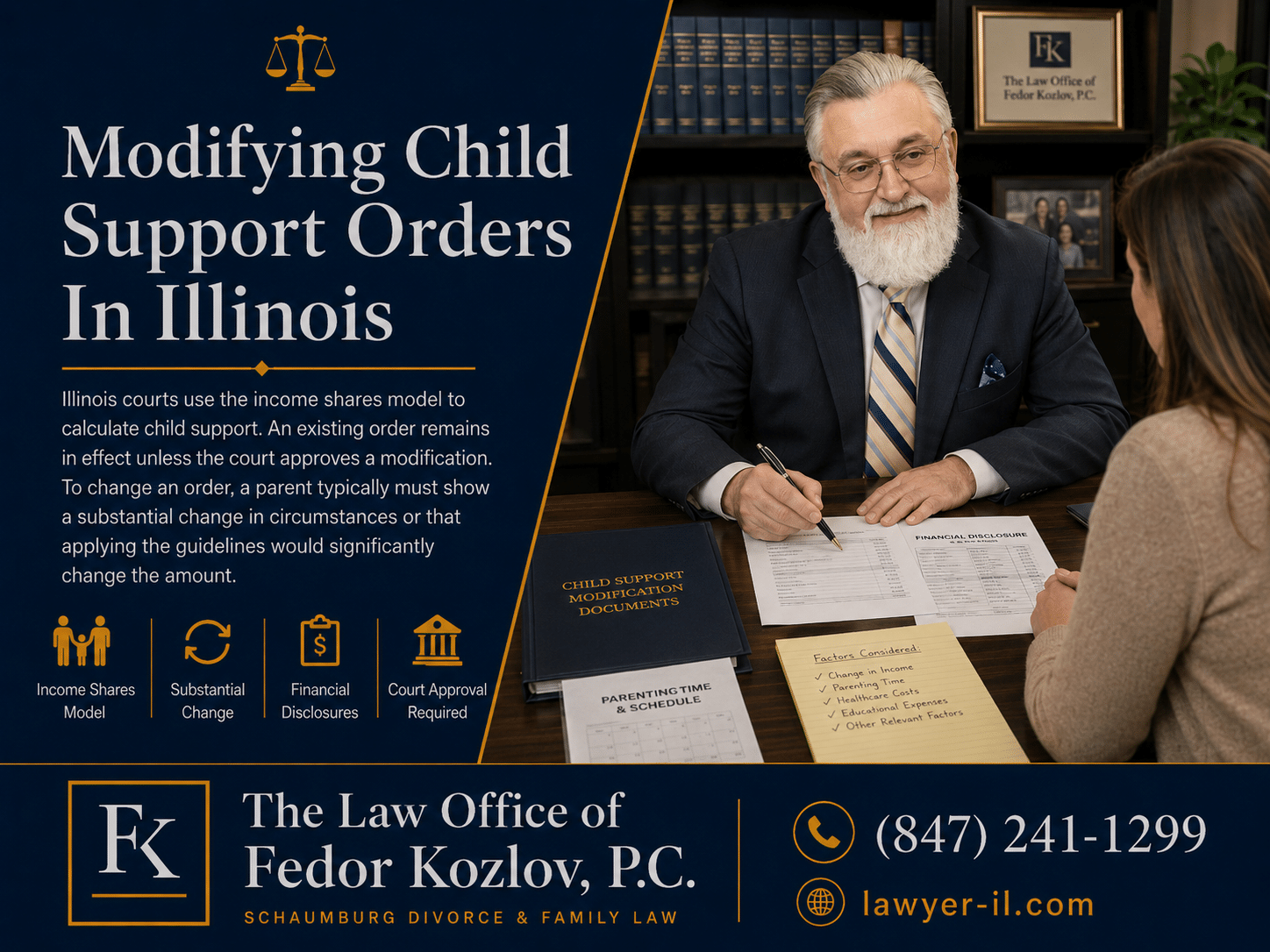
Child support orders are not permanent. Financial situations and a child’s needs can change over time, and Illinois law allows support arrangements to be updated to reflect current circumstances. Whether you pay or receive child support, it is important to understand when and how modifications may occur. A support order remains legally enforceable until changed by a court, so informal agreements between parents can lead to significant legal and financial issues. I represent parents on both sides of child support disputes throughout Schaumburg and Illinois, helping clients achieve fair outcomes that protect their financial stability and their children’s well-being.
Understanding Child Support Modification In Illinois
Illinois courts calculate child support using the “income shares” model under 750 ILCS 5/505. This law considers both parents’ incomes and each parent’s parenting time. Once a judge enters a child support order, the amount remains in effect unless the court approves a modification.
A child support modification may increase or decrease the amount of support depending on the circumstances. The parent requesting the change has the burden of showing that a substantial change in circumstances has occurred. Illinois courts may also modify support without a substantial change if applying the current statutory guidelines would result in a significant difference from the existing order.
Child support modifications can be contentious, often involving financial records, employment history, parenting responsibilities, and questions about a parent’s conduct or earning capacity. These disputes typically require substantial evidence and detailed financial disclosures.
What Qualifies As A Substantial Change In Circumstances?
Under 750 ILCS 5/510(a), Illinois courts may modify a child support order when a substantial change in circumstances exists. Several situations may justify a modification request.
A parent may lose a job, experience reduced income, or face medical issues that limit earning ability. Conversely, a parent may receive a promotion, bonus, inheritance, or increased income that justifies a higher support obligation. Changes in the child’s needs, such as new medical, educational, or extracurricular expenses, can also support a modification request.
Parenting time changes may also affect child support calculations. If one parent begins exercising substantially more parenting time than before, the support formula may need adjustment under Illinois law.
Courts consider all relevant circumstances when reviewing modification requests. Temporary financial setbacks typically do not justify permanent changes, especially if the parent’s income is expected to recover soon.
Voluntary Unemployment And Underemployment Issues
Illinois courts scrutinize cases where a parent voluntarily leaves employment or intentionally reduces income. Judges may impute income, calculating support based on earning potential rather than actual earnings.
For example, if a parent leaves a high-paying job without reasonable cause or works fewer hours to lower support obligations, the court may deny the modification request. Courts review employment history, education, job opportunities, and prior earnings when deciding whether to impute income.
Parents should understand that failing to seek employment in good faith can harm their credibility in court.
How To Request A Child Support Modification
A parent seeking modification must file a petition with the court that issued the original child support order. Filing does not automatically change the obligation; the current order remains enforceable until a judge issues a new one.
The modification process often involves:
- Filing a petition for modification
- Exchanging financial disclosures
- Providing tax returns and pay records
- Attending court hearings or mediation
- Presenting testimony and evidence
Illinois law generally does not allow retroactive modifications before the filing date of the petition under 750 ILCS 5/510(a). This means delaying action can become costly. A parent who loses income but waits several months to file may still owe the full amount of support that accumulated before the filing date.
Enforcement Problems Related To Child Support Orders
Many modification cases arise when a parent falls behind on support obligations. Illinois courts take enforcement seriously, and failure to comply with a support order can result in significant penalties.
Under Illinois law, enforcement measures may include:
- Wage garnishment
- Tax refund interception
- Suspension of driver’s licenses
- Liens against property
- Contempt proceedings
- Potential jail time in serious cases
A parent cannot stop paying support due to changed circumstances without court approval. Ignoring court orders can lead to escalating financial and legal consequences.
Child Support And Parenting Issues
Although child support and parenting time are related in some respects, Illinois courts treat them as separate legal matters. A parent generally cannot withhold visitation because support has not been paid. Likewise, a parent cannot stop paying support because parenting time disputes exist. Family law cases often involve overlapping issues such as child support, parental responsibilities, visitation schedules, and paternity. Changes in one area can affect another; for example, a significant increase in parenting time may justify modifying child support obligations.
Under the Illinois Marriage and Dissolution of Marriage Act, courts focus primarily on the child’s best interests when addressing family law disputes.
Why Legal Representation Matters In Child Support Modification Cases
Child support disputes can become legally and financially complex. Even a seemingly minor modification may have long-term consequences for both parents and children. Court procedures, evidentiary requirements, and statutory guidelines can create challenges for individuals handling these matters alone.
I represent clients throughout Schaumburg and the Chicago area in family law matters involving divorce, child support, custody disputes, visitation rights, paternity cases, and post-decree modifications. Whether you are seeking additional support or defending against an unfair request, having experienced legal guidance can make a substantial difference in the outcome of your case.
FAQs About Modifying Child Support Orders In Illinois
Can Child Support Be Modified If I Lose My Job?
Yes. Losing employment may qualify as a substantial change in circumstances under Illinois law. However, the court will examine why the job loss occurred and whether you are making reasonable efforts to secure new employment. A judge may deny relief if it appears that the unemployment is voluntary or temporary. You should file a petition for modification as soon as possible because unpaid support continues accumulating until the court enters a new order.
Can Parents Agree To Change Child Support Without Going To Court?
Parents may agree on a different amount, but the agreement should be formally approved by the court. Informal arrangements can create serious problems because the original order remains enforceable until modified by a judge. A parent who relies on a verbal agreement could later face claims for unpaid support, interest, and enforcement actions.
How Often Can Child Support Be Modified In Illinois?
There is no strict limit on how often a parent may seek modification. However, the requesting parent must present legally sufficient grounds for the change. Courts generally expect meaningful changes in financial circumstances, parenting time, or the child’s needs before granting relief.
Does Remarriage Affect Child Support?
Remarriage alone does not automatically change child support obligations. However, remarriage may indirectly affect financial circumstances. For example, if a parent’s household expenses decrease significantly because of remarriage, the court may consider broader financial realities when reviewing modification requests.
What Happens If A Parent Hides Income?
Illinois courts take hidden income allegations seriously. A judge may review bank records, business documents, tax filings, and other financial evidence to determine actual earnings. Courts may impute income, award attorney’s fees, or impose sanctions if a parent intentionally conceals assets or earnings.
Can Child Support Continue After A Child Turns 18?
In some situations, yes. Under 750 ILCS 5/513, Illinois courts may order contributions for college expenses and certain educational costs after a child reaches adulthood. Courts evaluate multiple factors when determining whether post-secondary educational support is appropriate.
Can Parenting Time Changes Affect Child Support?
Yes. Parenting time directly impacts child support calculations under Illinois’ income shares model. A significant increase or decrease in overnight parenting time may justify modification of support obligations.
Do I Need To Return To The Same Court That Issued The Original Order?
Generally, modification requests are filed in the court that entered the existing child support order. However, jurisdictional issues can become more complicated if one or both parents relocate outside of Illinois.
What If My Ex-Spouse Refuses To Provide Financial Information?
Illinois courts can compel financial disclosure during family law proceedings. Failure to provide required records may result in sanctions or adverse findings by the court. Financial transparency is critical in support modification cases.
Can A Child Support Modification Be Retroactive?
Illinois law generally limits retroactive modification to the date the petition for modification was filed. This is why acting quickly is important when financial circumstances change significantly.
Call Our Schaumburg Divorce Attorneys To Discuss Your Legal Rights
Child support modifications can affect your financial future and your relationship with your child. Whether you are seeking to increase support, reduce payments, enforce an order, or respond to a modification request, having experienced legal representation matters. I represent parents on both sides of family law disputes involving divorce, custody, visitation, paternity, and child support throughout Illinois.
If you need help with a child support modification case in Schaumburg or anywhere in the Chicago area, contact the Law Office of Fedor Kozlov today. I represent clients throughout Schaumburg and across Illinois in divorce and family law matters involving child support, parenting time, custody disputes, and paternity issues. Contact our Schaumburg child support attorneys at the Law Office of Fedor Kozlov at (847) 241-1299 to receive a consultation.
